Xi'an Jiaotong University Ma's group Researchers Develop High-Performance Chemically Mediated Artificial Nerves
In recent years, with the rapid development and in-depth integration of brain science, regenerative medicine, artificial intelligence, and other fields, technologies such as biological nerve repair and brain-computer interfaces are gradually transforming from concepts into reality. Artificial nerves are an important technology for clinical nerve repair and brain-computer interfaces, requiring the ability to integrate and transmit weak yet high-frequency signals (up to 1 kilohertz, below 50 millivolts) in living organisms. This demands that artificial nerves simultaneously possess fast response, high amplification capability, and good biocompatibility, while achieving the integrated fusion of sensing-processing-memory functions. Although traditional silicon-based circuits offer powerful performance, they lack the ability to respond to biochemical signals such as neurotransmitters, cannot achieve chemical regulation, and suffer from complex circuit structures and high rigidity. These limitations lead to critical issues including poor biocompatibility and difficulty in establishing long-term stable connections with soft neural tissues. The human nervous system can perceive external information, transmit signals to the central nervous system for processing, and form corresponding memories. An ideal artificial nerve must simulate this complete process, realizing signal reception, amplification, processing, and memory functions to truly replace damaged nerves and restore normal neural function.
To achieve these goals, the research team led by Professor Wei Ma from the State Key Laboratory for Mechanical Behavior of Materials at Xi'an Jiaotong University focused on solving two core technical challenges: first, how to simultaneously achieve efficient ionic transport (the mode of neural signal transmission) and electronic transport (the working mode of electronic devices) to meet the performance requirements of artificial nerves; second, how to balance device performance and biocompatibility, avoiding the sacrifice of cell-friendliness when enhancing performance. The team designed a vertical organic electrochemical transistor (v-OECT) with a gradient-intermixed bicontinuous structure (GIBS), where ion conductors with biocompatibility and molecular doping effects were sequentially deposited on the vertical channel of the polymer semiconductor. This GIBS structure forms continuous high-speed transport channels for both electrons and ions while achieving n-type doping, thus addressing the long-standing challenge of inefficient simultaneous charge and ion transport. Additionally, the GIBS structure inhibits the destruction of the crystalline structure of the underlying polymer semiconductor by the upper ion conductor, provides a high ion insertion/extraction barrier for long-term ion storage, and ensures excellent conductance memory performance. The upper ion conductor also promotes cell growth, providing a highly biocompatible neural interface for the device.
Benefiting from this "three-in-one" design, the v-OECT with GIBS exhibits a high transconductance of 13.7 mS, an ultra-fast response speed of 27 μs, and a comprehensive performance metric (gm/τ) of 519 S/s, which is the highest among all reported n-type OECTs to date. As a sensor, it can achieve high-sensitivity responses to multi-modal signals such as optical, electrical, and chemical stimuli; as a neuron, it can achieve a high voltage gain of 248 V/V and a high cutoff frequency of 1.5 kHz through complementary inverters; as a synapse, it can realize high-frequency conductance reading/writing at 100 kHz and conductance memory retention exceeding 1000 s. The artificial nerve constructed by the homogeneous integration of these three components not only possesses excellent biocompatibility and long-term implantation stability but also can achieve sensing-processing-memory functions for external signals at frequencies exceeding 250 Hz under calcium ion-mediated chemical regulation, covering the refresh frequency range of all known biological nerves. Through implantation experiments, this technology successfully restored conditioned reflex capabilities in mice with impaired neural function. This research holds significant scientific value and application prospects in the fields of organic semiconductors and emerging neuroelectronics, providing new ideas for the development of brain-computer interfaces and the treatment of various neurological diseases, particularly for the repair of spinal cord injuries, peripheral nerve injuries, and other conditions.
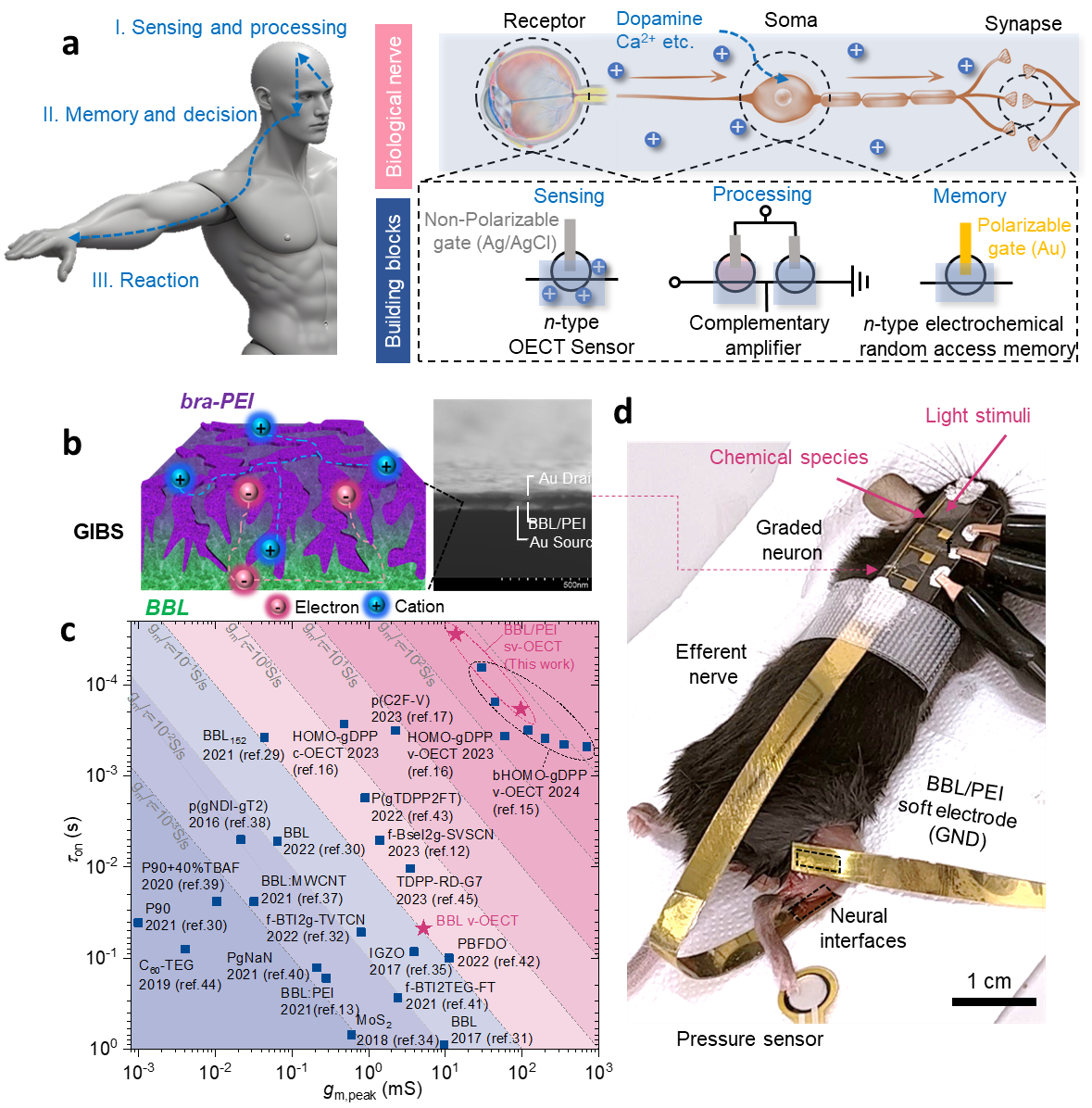
Figure 1 | a, Composition and corresponding relationships between biological nerves and artificial nerves; b, Schematic diagram of the gradient-intermixed bicontinuous structure (GIBS); c, Comparison of the overall performance of v-OECT with GIBS and other reported devices; d, Artificial nerves used to restore conditioned reflex capabilities in mice with impaired neural function.
Related research results were published in Nature Electronics, a top international journal in the field of electronics, under the title "A high-frequency artificial nerve based on homogeneously integrated organic electrochemical transistors". Dr. Shijie Wang, Assistant Professor at the State Key Laboratory for Mechanical Behavior of Materials, Xi'an Jiaotong University, is the first author of the paper. Professor Wei Ma, Associate Professor Chao Zhao, and Assistant Professor Bingjun Wang serve as corresponding authors. The State Key Laboratory for Mechanical Behavior of Materials at Xi'an Jiaotong University is the first corresponding unit. Collaborators of the paper include Professor Gang Bao from the First Affiliated Hospital of Xi'an Jiaotong University, Professor Yong Han from Xi'an Jiaotong University, Professor Yuxiang Li from Xi'an University of Science and Technology, Professor Stephan V. Roth from the Deutsches Elektronen-Synchrotron (DESY), and Professor Peter Müller-Buschbaum from the Technical University of Munich, Germany. This work was supported by the National Key Research and Development Program of China, the National Natural Science Foundation of China for Young Researchers (Doctoral Students), the Program of Introducing Talents of Discipline to Universities ("111 Program"), and the Key Science and Technology Innovation Team of Shaanxi Province, among other projects.
Paper link: https://www.nature.com/articles/s41928-025-01357-7




 Chinese